
Natech Trade Finance, developed with

Microfinance in Romania: What the EMN 2026 Panel Taught Us About Compliance
Insights from the Romanian microfinance panel at EMN 2026 in Barcelona: young members, rules built for banks, the 2027 EU AML Regulation, and why credit unions should share compliance.

Table of contents
By Dumitru Bucșe, Senior Business Development Representative, Natech Banking Solutions
Romania’s credit unions and microfinance lenders face three pressures at once. Young people expect to join online, in minutes. Rules designed for banks apply to them in full. And from July 2027, the new EU Anti-Money Laundering Regulation (AMLR) will apply to them exactly as it does to large banks.
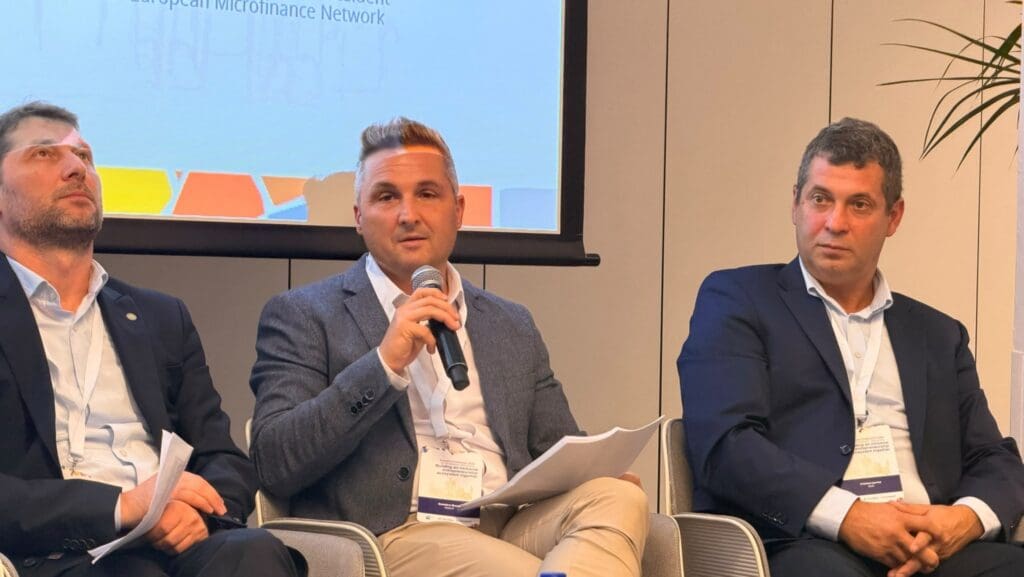
These were the topics of the panel on microfinance in Romania at the European Microfinance Network (EMN) Annual Conference 2026 in Barcelona, on October 15–16. I represented Natech, together with leaders from UNCAR and AsCAR, Romania’s national associations of credit unions, Corporația de Finanțare from the Republic of Moldova, Vitas Romania and BT Mic. Ștefan Buciuc, CEO of BCR Social Finance, moderated.
Below are the four themes we discussed and what each means in practice for Romanian credit unions, known as mutual aid houses (case de ajutor reciproc, or CARs), and for non-bank financial institutions (IFNs).
Key Takeaways for Microfinance in Romania
Across all four themes, the same pattern came up. The member relationship stays with each institution. Technology and compliance become shared services.
| Theme | The challenge | What it means in practice |
|---|---|---|
| Demographics | Younger members expect to join and borrow digitally, and on a digital channel trust has to be built through processes, not personal relationships. | Online onboarding with remote identity verification, automatic sanctions and PEP screening, and customer due diligence built in from the start. |
| Regulation | Obligations designed for banks, such as FATCA/CRS, apply equally to small lenders. From July 10, 2027, the EU AML Regulation applies directly, with no national adaptation. | Proportionate guidance for small entities, and obligations that repeat at every credit union automated once, at union level. |
| Technology | Fintech sets the standard for customer experience, and small institutions need technology that fits their size. | AML rules calibrated to real client profiles, so legitimate clients, such as farmers with seasonal income, are not flagged or rejected. |
| Sustainability to 2030 | Compliance costs are largely fixed, so they weigh far more on small institutions. | Shared compliance services (lists, monitoring rules, reporting, training), while the member relationship, lending decisions and legal responsibility stay with each institution. |
1. Demographics: Trust and the Next Generation of Members
A trust-based model under pressure. The panel agreed the sector is moving toward a hybrid model: in-person relationships for current members, and a digital channel for younger generations.
The hybrid model is the right direction. But on the digital channel, trust is built differently. A new member doesn’t know the credit union’s management, so trust comes from processes: correct identification, clean data, reporting on time. Trust that can be verified becomes a competitive advantage, and it is what makes membership of a supervised, affiliated credit union worth something.
In practice:
- A digital member file: identity, source of income and risk profile, updated periodically, not only at onboarding.
- An automatic history of every action: who approved, when and on what basis. During a National Bank of Romania (NBR) inspection, the credit union can show the full process behind each decision.
- Reports generated from the system, not filled in manually in Excel.
- A minimum set of common standards at union level, so that “affiliated credit union” becomes a quality guarantee for members.
Attracting people under 35. Young people are the main challenge, together with retaining existing members, and the sector is already investing in mobile apps and online onboarding.
For young people, the minimum is online onboarding with remote identity verification, done in a few minutes, as they’re used to from apps. But this only works if customer due diligence is built correctly from the start. Otherwise, digital onboarding becomes a risk.
In practice:
- Scanning the ID document and confirming the person is real, via selfie or a short video call, within the limits the NBR allows for remote identification.
- Automatic screening against sanctions lists and lists of politically exposed persons (PEPs) right at onboarding.
- An automatically calculated risk profile: simple cases go straight through, and people only handle the exceptions.
- The flow can plug into apps credit unions already use, so nothing is built from scratch.
2. Regulation: An Outdated Framework and the 2027 EU AML Regulation
The panel saw Romania’s credit union law, Law 122/1996, as a solid base. The harder questions are about consistent supervision across the sector and about rules built for banks that land, unchanged, on very small institutions.
Two examples came up:
- FATCA/CRS: under the US Foreign Account Tax Compliance Act (FATCA) and the OECD Common Reporting Standard (CRS), CARs must register and report non-resident members, even when in practice they have none. It’s a cost with little benefit, especially in rural areas.
- Collateral: the sector would welcome more flexibility in the types of collateral credit unions can accept.
The FATCA/CRS example says it all: an obligation designed for banks, applied identically to a rural CAR with no non-resident members. The same will happen from July 10, 2027, when the EU AML Regulation applies directly, with no national adaptation.
That’s why the realistic request to the authorities is proportionality: guidelines adapted for small institutions, and recognition of shared solutions at union level. Obligations that repeat in exactly the same way at every credit union can be automated once, at union level, for all affiliated credit unions.
In practice:
- FATCA/CRS made light: at onboarding, the member fills in a tax residency self-certification. The system flags only cases with non-residency indicators and generates the report. For a credit union with no non-residents, the effort drops to almost zero.
- A shared library of AML policies and procedures, updated at union level when the law changes, not rewritten by each credit union.
- A proportionality guideline from the NBR and Romania’s National Office for Prevention and Control of Money Laundering (ONPCSB) for small entities, with explicit recognition of the unions’ shared solutions.
- Shared operations, individual responsibility: the EU AML Regulation allows operational tasks to be outsourced. Responsibility stays with each credit union, but the work can be done jointly.
3. Technology: AML for Underserved Clients, Without False Alarms
Lenders serving underserved clients shared a clear picture of the market:
- Upcoming regulatory changes on governance and collateral will need careful attention.
- Guarantee support is tight, and new EU guarantee programs are expected later than first planned.
- The opportunity is large: more than 1.2 million small companies and sole traders fit the microfinance profile, and many still finance themselves mainly through supplier credit.
- Financial education remains part of the answer.
With guarantees arriving later, risk assessment at loan origination becomes the main protection. This is where AML and credit risk work together, because they use the same client data. A poorly calibrated AML transaction monitoring system produces false alerts and rejects exactly the clients we want to include. A well-calibrated one lets you accept the client and monitor them intelligently. A farmer with seasonal income, for example, shouldn’t trigger an alert at every harvest.
In practice:
- Segmentation by client type (farmer, sole trader, startup, employee), with different alert thresholds for each.
- Periodic recalibration: alerts that have repeatedly proven false adjust the rule instead of repeating endlessly.
- Alerts ranked by risk, so the analyst starts with the important ones.
- Collect once, use twice: data collected at onboarding (income, activity) serves both AML and the creditworthiness assessment required by the new Consumer Credit Directive from November 2026.
Moldova: preparing for EU rules early. The panel also looked at the Republic of Moldova’s EU accession path. Capital and companies cross the border in both directions, and both markets need data on clients’ payment behavior.
For non-bank lenders in Moldova, EU AML rules arrive before actual accession. Whoever builds their processes on the EU standard now won’t have to redo them. And some costs make no sense for each institution to pay separately.
In practice:
- Local PEP lists built and updated jointly by the association, not by each lender separately.
- Screening that recognizes the same name in Latin and Cyrillic, for example Șamatailo and Шаматаило. A small problem, but a very real one for institutions in Moldova.
- Processes built on the structure of the EU Regulation from now on, so nothing needs rebuilding at accession.
- Exchange of payment behavior data between Romania and Moldova, through bilateral agreements and in compliance with the EU General Data Protection Regulation (GDPR).
- EU technical assistance for candidate countries can cover part of the cost.
4. Sustainability to 2030: The Cost of Being Small
The question put to Natech was direct: is compliance becoming the biggest obstacle for small institutions?
Compliance becomes an obstacle when each institution carries it alone.
The cost of compliance for smaller institutions is largely fixed. Studies show that small institutions pay, relative to their size, up to five times more than large ones. The panel gave concrete examples: FATCA reporting for non-resident members who don’t exist, risk assessment without EIF guarantees, online onboarding for young people. And from July 2027, the EU AML Regulation applies in the same way to a large bank and to a CAR with a few thousand members.
The good news is that this sector has the answer in its DNA: mutual help. If small institutions pool what costs the same for everyone (sanctions and PEP lists, monitoring rules, reporting and training), the cost per member drops significantly. The union can do for compliance what it already does for audit and legal advice.
So yes, compliance can become the biggest obstacle, but only if each of us deals with it alone.
What a shared compliance platform could look like
A single cloud platform, with data hosted in the EU. Each credit union has its own separate space, and the union manages the shared part.
| Shared at union level | Stays with each credit union |
|---|---|
| Sanctions and PEP lists | The member relationship |
| Monitoring rules | The lending decision |
| ONPCSB reporting templates | Legal responsibility |
| Annual training and legislative updates |
- Pricing per member, not a license per institution. A credit union with 3,000 members pays in proportion to its size.
- Start with a pilot with a few affiliated credit unions, then expand.
Through cooperation, even the smallest credit unions can reach the economies of scale that large institutions take for granted.
Can artificial intelligence solve the problem?
A follow-up question went to all panelists. AI helps prioritize alerts and reduce false positives, but the regulator wants explainable decisions. And AI-based credit scoring is considered high-risk under the EU AI Act. So yes to AI, but with a human in the loop and transparent rules.
Frequently Asked Questions
What is a CAR in Romania?
A CAR (casa de ajutor reciproc) is a Romanian credit union. There are about 3,000 in the Register, and about 1,000 are affiliated with UNCAR or AsCAR.
When does the EU AML Regulation apply?
From July 10, 2027. It applies directly in every member state (see our breakdown of the EU AML Package and its operational impact), with no national adaptation, to large banks and small credit unions alike.
Can small credit unions share AML compliance?
Yes. The EU AML Regulation allows operational tasks to be outsourced. Lists, rules, reporting and training can be shared at union level, while legal responsibility stays with each credit union.
Can AI handle AML for small lenders?
AI helps prioritize alerts and cut false positives. But regulators want explainable decisions, and AI credit scoring is high-risk under the AI Act, so a human stays in the loop.
Let's Talk
Running a credit union or non-bank lender in the EU and preparing for July 2027? Get in touch with our team to discuss how shared, right-sized AML compliance could work for your institution. You can also read our answers to the AML questions Romanian and Moldovan lenders raised at the SIFTA Workshop.